

Start with your Google Business Profile verified, your NAP consistent across every listing, and your top three product pages live. That's the core of dispensary SEO, and it's where over 60% of cannabis shoppers already begin their journey. Because paid advertising is largely off the table for cannabis and hemp brands, organic and local search aren't just one channel among many. They're your primary acquisition engine. The immediate next step: run a GBP audit this week, fix any inconsistencies in your business name, address, and phone number, then schedule a 30-day technical and content sprint. Tools like Google Search Console and Google Business Profile Insights will tell you exactly where you're losing traffic before you spend a dollar on anything else. Elmtmarketing builds these programs specifically for 21+ brands, connecting local map visibility to revenue outcomes rather than treating SEO as a standalone tactic.
Table of Contents
- Why dispensary SEO is different from standard retail SEO
- What are the core pillars of a dispensary SEO program?
- Which listings and directories should you claim first?
- Website and technical checklist for dispensary sites
- How do you choose the right agency for dispensary SEO?
- What does a 30/90/180-day dispensary SEO roadmap look like?
- What KPIs and costs should you expect from dispensary SEO?
- What should you ask your team or agency this week?
- Key Takeaways
- Why the channel-first mindset keeps dispensaries stuck
- Elmtmarketing builds dispensary SEO as a revenue system, not a checklist
Why dispensary SEO is different from standard retail SEO
Most retail businesses can run Google Ads, Meta campaigns, and retargeting without a second thought. Cannabis and hemp brands can't. Paid advertising channels are restricted for cannabis businesses on nearly every major platform, which means organic search and local listings carry the full weight of customer acquisition. That constraint changes everything about how you prioritize your marketing budget.
Compliance adds another layer. Product language on dispensary sites must avoid therapeutic claims that could trigger regulatory scrutiny. Age-gated content requires careful implementation so it doesn't block search engine crawlers from indexing your pages. Categories on platforms like Google Business Profile need to be selected precisely, because a miscategorized listing can suppress your map-pack visibility entirely.
The directory ecosystem is also different. General retail brands lean on Yelp and Google. Dispensaries need those, plus vertical platforms like Leafly and Weedmaps, which send high-intent traffic from shoppers who are already in buying mode. Each platform has its own optimization logic, its own category taxonomy, and its own review system.
Pro Tip: Treat your GBP and Google Maps presence as both a discovery channel and a last-mile conversion tool. Optimize hours, photos, and menu details first. A shopper who finds you on Maps and sees an outdated menu or wrong hours is a lost sale.
What are the core pillars of a dispensary SEO program?
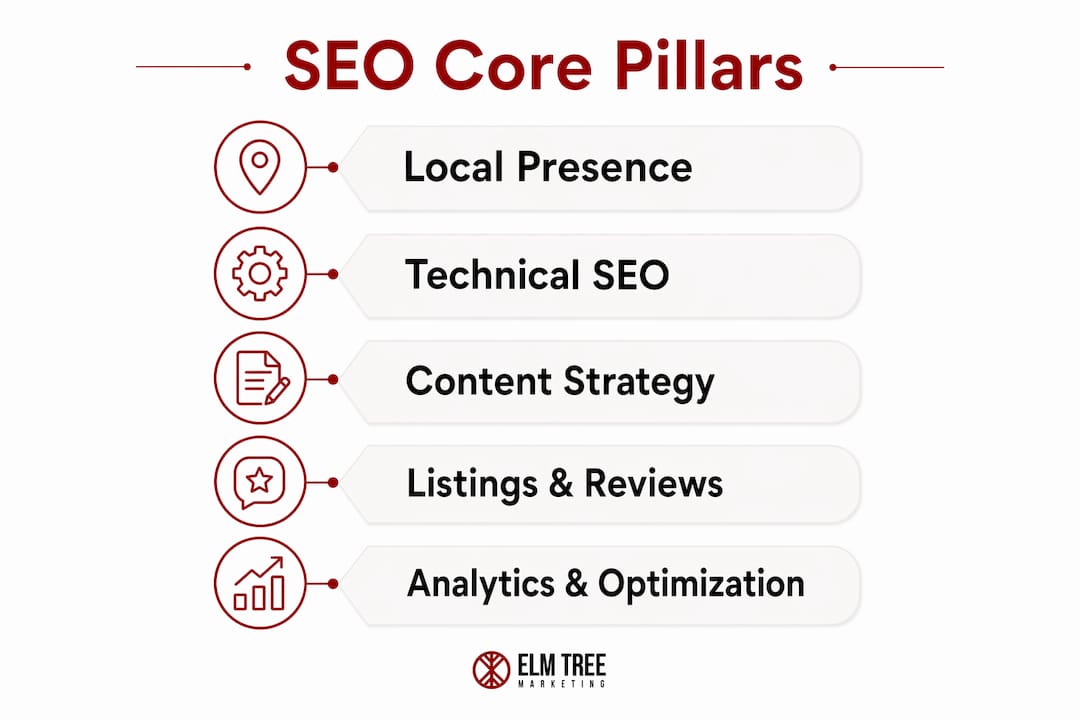
Every effective SEO program for dispensaries runs several workstreams at once. Letting one lag creates gaps that competitors fill.
The eight pillars:
- Google Business Profile — verification, category selection, photos, posts, and menu/product details
- Local citations and directories — consistent NAP across Apple Maps, Bing Places, Yelp, Leafly, and Weedmaps
- On-site product and service pages — dedicated pages for each strain category, product type, or service
- E-commerce readiness — secure checkout, product schema, and inventory integration where applicable
- Technical SEO — mobile-first design, page speed, HTTPS, canonicalization, and crawlability
- Content clusters — educational FAQs, menu pages, and buying guides that capture mid-funnel searches
- Reviews and reputation — proactive solicitation, response playbooks, and monitoring
- Backlinks — local press, chamber listings, and cannabis-adjacent editorial coverage
30-day starter tasks (prioritized):
- Verify your GBP and complete every field, including business description, categories, and hours
- Build product or menu page templates for your top three categories
- Add LocalBusiness and Product schema markup to your homepage and product pages
- Set up a review-request flow via SMS or email after each purchase
These pillars aren't independent. Schema on your product pages feeds GBP rich results. Review volume feeds local ranking signals. A fast, mobile-optimized site improves both organic rankings and conversion rates from Maps traffic.
Which listings and directories should you claim first?
Not all directories deliver equal value. Prioritize by impact on map-pack visibility and buyer intent.

| Listing | What to claim | Primary impact | Setup time |
|---|---|---|---|
| Google Business Profile | NAP, categories, hours, photos, menu/products, posts | Map-pack ranking, direction requests | 1–3 hours |
| Apple Maps | NAP, hours, photos, category | iOS Maps visibility | 30–60 minutes |
| Bing Places | NAP, hours, photos | Bing local results | 30 minutes |
| Yelp | NAP, photos, hours, menu | Review discovery, click-throughs | 1–2 hours |
| Leafly | Full product menu, photos, hours, deals | High-intent cannabis shoppers | 2–4 hours |
| Weedmaps | Full product menu, photos, hours, deals | High-intent cannabis shoppers | 2–4 hours |
GBP listings power the Google 3-Pack for "dispensary near me" searches, making it the highest-leverage listing by a wide margin. Claim and verify it before touching anything else.
NAP consistency across every listing is a baseline ranking signal. A single address formatted differently across directories creates conflicting signals that suppress local rankings.
Pro Tip: On Leafly and Weedmaps, invest real time in category selection and product-level details. Shoppers on those platforms are already decided on cannabis. They're choosing between you and the dispensary two miles away based on menu depth, photos, and deal visibility.
Website and technical checklist for dispensary sites
Technical SEO for dispensaries has a few requirements that general retail sites don't face.
Core technical must-haves:
- Mobile-first design with a sub-two-second load target on 4G connections
- HTTPS with HSTS headers enabled across the entire domain
- Canonical tags on all product and category pages to prevent duplicate content
- LocalBusiness, Product, and Offer schema markup where platform policies allow
- Google Search Console verified, sitemap submitted, and crawl errors resolved
- Structured data validation via Google's Rich Results Test
Age-gating done right:
Client-side JavaScript popups are the most common age-gate implementation, and they're also the most problematic for SEO. Search engine crawlers often can't execute JavaScript, which means they may not index your content at all. Server-side age verification, or a lightweight JavaScript gate that still renders page content to crawlers, is the better path. The goal is compliance without blocking indexation.
| Technical task | Tool to use | Priority |
|---|---|---|
| Core Web Vitals audit | Google Search Console | High |
| Schema validation | Rich Results Test | High |
| Crawl error review | Google Search Console | High |
| Image lazy-loading | Developer / CMS plugin | Medium |
| Server caching setup | Hosting provider / CDN | Medium |
| HSTS implementation | Hosting / server config | High |
How do you choose the right agency for dispensary SEO?
The cannabis and hemp space has attracted a lot of generalist agencies that claim vertical expertise they don't have. Here's how to cut through it quickly.
Trust signals to require before signing anything:
- Case studies from 21+ or local retail clients, with specific KPIs (not just "we increased traffic")
- Sample reporting dashboards showing GBP Insights, Search Console data, and conversion metrics
- References from dispensary or hemp brand clients you can actually call
- A clear process for handling age-gated content and compliance language
Questions to ask in your first call:
- How do you handle GBP optimization for cannabis categories specifically?
- What's your approach to local link building in a restricted vertical?
- How do you structure content to stay compliant while still ranking for product terms?
- What does your reporting cadence look like, and which KPIs do you track weekly versus monthly?
- Can you show me a before-and-after from a dispensary or 21+ client?
Red flags that end the conversation:
- Guaranteed #1 rankings for specific keywords
- Citation-building packages that use low-quality directory networks
- No mention of compliance or age-gating in their proposal
- Vague deliverables with no timeline or ownership assigned
Pro Tip: Score agencies on four dimensions: pricing model (project vs. retainer), timeline to first impact, what's included (listings, content, technical, link outreach), and compliance awareness. A low monthly retainer that excludes technical work and content is rarely the deal it looks like.
What does a 30/90/180-day dispensary SEO roadmap look like?
Dispensary SEO compounds over time. The first 30 days are about fixing what's broken and claiming what's yours.
30-day priorities:
- Verify GBP and complete all profile fields
- Fix NAP inconsistencies across existing listings
- Publish top three product or menu pages with schema
- Launch review-request flow via SMS or email
90-day priorities:
- Launch a content cluster targeting your top five transactional keyword groups
- Begin local link outreach (chamber of commerce, local press, cannabis-adjacent blogs)
- Run conversion-rate experiments on your highest-traffic landing pages
- Track initial ranking movement for product-category terms in Search Console
180-day priorities:
- Scale content to cover the full product taxonomy and educational FAQ cluster
- Refine backlink profile with editorial placements
- Build or improve email and SMS retention flows to increase repeat visit rate
- Measure revenue per visitor and adjust content strategy based on what converts
| Phase | Key deliverable | Expected impact | Owner |
|---|---|---|---|
| 30 days | GBP verified, NAP fixed, product pages live | Local visibility improvement | Agency or in-house |
| 90 days | Content cluster + local links | Ranking movement for product terms | Agency |
| 180 days | Full content scale + retention flows | Organic revenue growth | Agency + in-house |
What KPIs and costs should you expect from dispensary SEO?
Primary KPIs to track:
- GBP views, clicks, and direction requests (via GBP Insights)
- Organic traffic for transactional keywords (via Google Search Console)
- Conversion rate: direction requests, click-to-order, or in-store visit attribution
- Review volume and average rating across GBP, Yelp, Leafly, and Weedmaps
- Revenue per visitor on product pages
Realistic timeline:
Local visibility improvements typically show within 30 days of GBP optimization and NAP cleanup. Ranking movement for product pages usually appears in the 60–90 day window. Strong organic revenue growth takes 6–12 months of consistent execution.
Businesses with photos see about 42% more direction requests, which makes a photo upload plan one of the fastest wins available. And 85% of consumers trust online reviews as much as personal recommendations, so review volume isn't a vanity metric. It directly influences both rankings and conversion.
Cost guidance: Dispensary SEO engagements typically run as either project-based audits and builds or monthly retainer programs covering listings management, content, technical maintenance, and link outreach. Project-based work suits brands that need a one-time foundation. Retainers make sense once the foundation is in place and you're scaling content and links. Elmtmarketing's structured revenue services cover both models for 21+ brands.
What should you ask your team or agency this week?
Start here. These are the questions and tasks that move the needle fastest.
Immediate asks:
- Pull up your GBP right now. Are hours, address, and phone number correct?
- Request Google Search Console access and check for crawl errors and coverage issues
- Ask your agency or developer for the last technical audit summary
- List your current directory citations and check NAP consistency across all of them
Quick wins to assign this week:
- Verify GBP if it isn't already verified
- Correct any wrong hours, address format, or phone number across listings
- Publish your top three product or category pages if they don't exist
- Draft a review-request template for post-purchase SMS or email
For in-house teams, focus the first week entirely on GBP and Search Console. Those two tools will surface the highest-impact problems without any additional spend. If you're handing this to an agency, expect a kickoff audit in week one, a prioritized fix list in week two, and first deliverables by day 30.
Key Takeaways
Dispensary SEO works when you own your local presence first, fix your technical foundation, and build content that converts high-intent searchers into in-store visits or orders.
| Point | Details |
|---|---|
| GBP is the top priority | Verify and fully optimize your Google Business Profile before any other SEO task. |
| NAP consistency matters | Inconsistent name, address, or phone across listings suppresses local rankings. |
| Photos drive direction requests | Businesses with photos see about 42% more direction requests, per Mediajel data. |
| Reviews influence rankings and trust | 85% of consumers trust online reviews as much as personal recommendations. |
| Elmtmarketing for 21+ brands | Elmtmarketing builds compliance-aware local SEO programs for dispensaries and hemp brands, connecting map visibility to measurable revenue outcomes. |
Why the channel-first mindset keeps dispensaries stuck
Most dispensary marketing conversations start with "which platform should we be on?" That's the wrong question. The right question is: what does a shopper see when they search for you, and does it give them a reason to walk through your door?
The brands that win local search aren't necessarily the ones with the biggest budgets. They're the ones that have claimed every listing, kept their hours accurate, responded to every review, and published product pages that actually answer what shoppers are searching for. That's not glamorous work. It's also not complicated. What makes it hard is consistency over time, which is exactly where most in-house teams run out of bandwidth.
The other thing worth saying plainly: local SEO for cannabis isn't a set-it-and-forget-it program. Google updates its local ranking algorithm regularly. Leafly and Weedmaps change their category structures. Review sentiment shifts. The dispensaries that hold their map-pack positions are the ones treating SEO as an ongoing revenue system, not a one-time project.
Elmtmarketing builds dispensary SEO as a revenue system, not a checklist
Dispensary and hemp brands that work with Elmtmarketing get more than a list of fixes. They get a structured revenue system built around their specific compliance constraints, local market, and conversion goals. That means GBP management, technical audits, product page builds, review systems, and content strategy delivered as a connected program, not disconnected tasks handed off to different vendors.
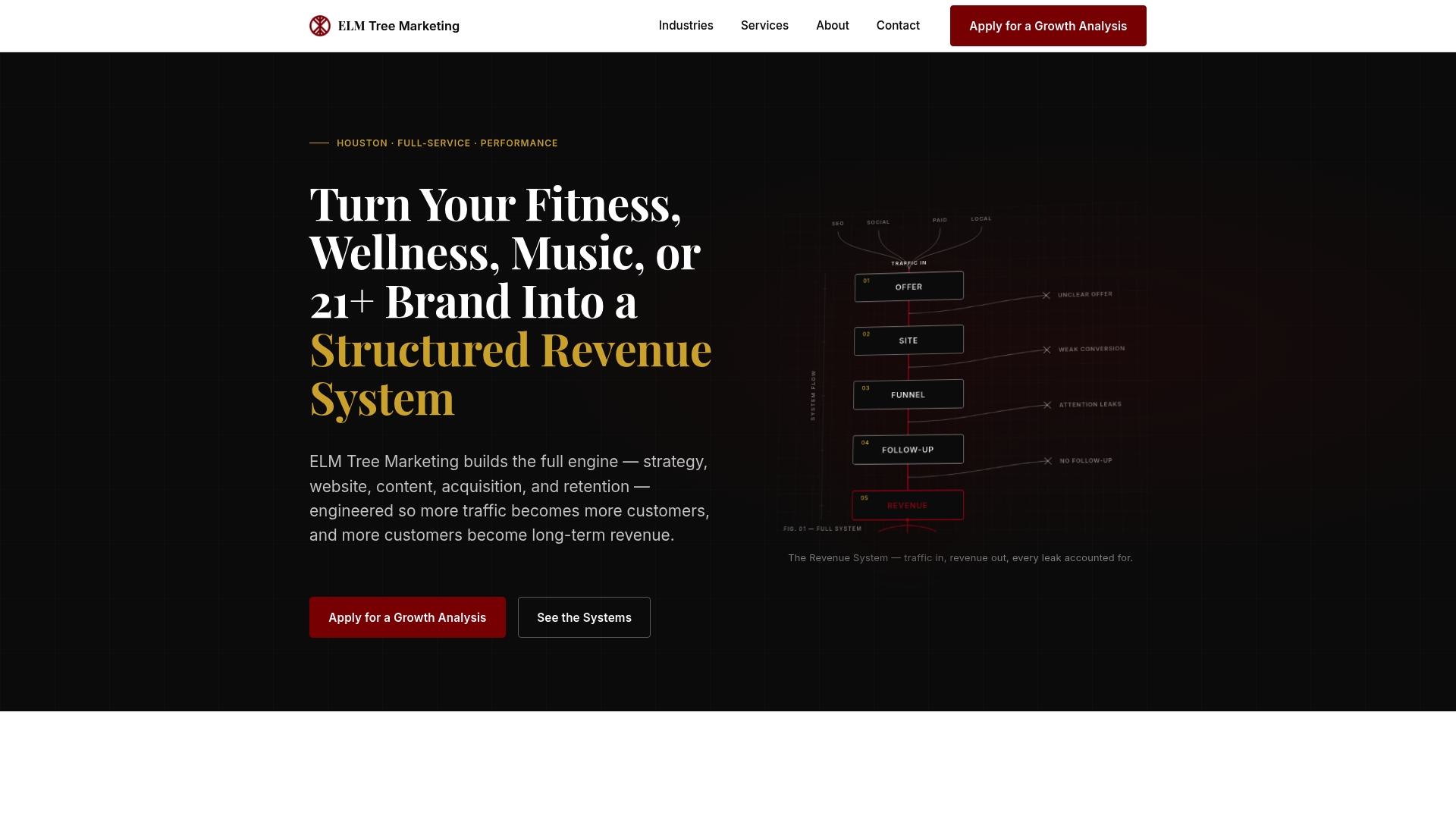
The difference shows up in the metrics: direction requests, organic traffic for product terms, and repeat customer rate, tracked and reported transparently every month. If you're ready to stop guessing which part of your local presence is leaking revenue, book a Growth Analysis at elmtmarketing.com and get a clear picture of where you stand and what to fix first.
Recommended
- 21+ Brand Marketing | Smoke, Hemp & Adult Beverage — ELM Tree Marketing
- Local SEO Houston | Google Business Profile — ELM Tree Marketing
- ELM Tree Marketing | Houston Marketing Agency for Fitness, Wellness, Music & 21+ Brands
- Fitness Marketing Agency | Gyms, Coaches & Fitness E-commerce — ELM Tree Marketing